In today’s hiring landscape, HR teams face increasing applicant volumes, rising competition for talent, and the pressure to make faster yet more reliable decisions. Hiring accuracy has never been more important. A single bad hire can cost months of productivity and significantly impact team performance.
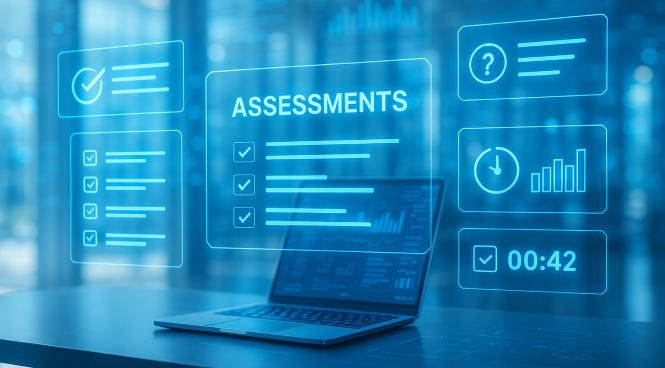
AI-powered assessments are becoming a critical part of modern recruitment, offering objective, scalable, and data-backed ways to evaluate candidates. Tools like Hirebee Assessments help companies bring more structure and consistency to their hiring process, while still allowing HR to maintain full control and oversight.
What Are AI-Powered Hiring Assessments?
AI-powered hiring assessments are digital evaluation tools that use machine learning to analyze candidates’ skills, competencies, and behavioral traits. Unlike traditional tests that rely solely on manual scoring, AI assessments can automatically interpret responses, identify patterns, compare results across large candidate pools, and highlight the strongest matches for a specific role. Types of AI Assessments include the following types
Cognitive Ability Assessments
These tests measure how candidates process information and solve problems. AI helps evaluate patterns in reasoning, memory, spatial awareness, numerical understanding, and verbal logic. Companies use them to identify candidates who can quickly learn, adapt, and make sound decisions in new situations. Examples include:
- Numerical reasoning tests
- Verbal reasoning tests
- Logical or abstract reasoning
- Short problem-solving tasks
- Adaptive cognitive challenges where difficulty changes based on answers
Skills Assessments
Skills assessments evaluate whether candidates have the technical or job-specific abilities required for the role. AI supports these tests by scoring answers consistently, analyzing accuracy, and sometimes reviewing work samples or code submissions. These assessments help teams confirm that candidates can actually perform the work, not just claim the skills. Common types are:
- Coding and programming tests
- Marketing, sales, or data-related tasks
- Language proficiency assessments
- Administrative or analytical tasks
- Industry-specific competencies (e.g., finance, customer support, engineering)
Personality and Behavioral Assessments
This category focuses on understanding work preferences, interpersonal style, and how someone behaves under different conditions. AI analyzes response patterns to match candidates with roles and environments where they’re likely to thrive. These tests are especially useful for assessing long-term team fit and predicting how well someone aligns with company culture. They measure traits such as:
- Communication style
- Work motivation
- Collaboration tendencies
- Adaptability and resilience
- Decision-making style
- Leadership potential
Job Simulations
Job simulations replicate real work situations, allowing candidates to demonstrate how they would react in the role. AI evaluates performance by analyzing decision pathways, prioritization patterns, and task outcomes. These assessments provide insight into practical ability and real-world performance, going beyond simple knowledge tests. Examples are:
- Email or inbox management simulations
- Customer support scenarios
- Project prioritization tasks
- Sales or negotiation simulations
- Data-cleaning or quality-check exercises
Situational Judgment Tests (SJTs)
SJTs present hypothetical workplace scenarios and ask candidates to choose or rate the best response. AI helps identify decision-making patterns, judgment quality, and alignment with role expectations. SJTs are especially effective for customer-facing, operational, or management roles. What they typically evaluate:
- Conflict resolution
- Ethical decision-making
- Teamwork
- Professional communication
- Leadership approach in specific situations
Language and Communication Assessments
These tests measure proficiency in written or spoken communication. AI can analyze grammar, tone, clarity, comprehension, and even spoken fluency in some systems. They help ensure candidates can communicate effectively in the required language. Used for roles like:
- Customer support
- Content writing
- Sales communication
- Administrative positions
Why Traditional Assessments Often Fall Short
While traditional assessments have been used for decades, they come with notable limitations:
- Subjective judgment can influence scoring and evaluation.
- Manual scoring slows down hiring, especially at scale.
- Inconsistency across reviewers leads to uneven candidate experiences.
- Bias may affect hiring decisions despite best intentions.
- Limited scalability makes it hard to assess hundreds of applicants quickly.
These challenges make it difficult for HR teams to make confident, data-driven hiring decisions, especially when competing for top talent.
How AI-Powered Assessments Improve Hiring Accuracy
1. Reduced Human Bias Through Data-Driven Scoring
AI evaluates candidates based purely on job-related criteria. Instead of relying on subjective impressions, assessments are scored using consistent algorithms designed to focus on skills, competencies, and behavioral indicators. This approach supports fair and inclusive hiring.
2. Standardized and Objective Evaluation
Every candidate receives the same test, is scored the same way, without variation between hiring managers. This level of consistency improves hiring accuracy and ensures compliance with internal and external hiring standards.
3. Faster, More Efficient Screening
AI assessments deliver immediate scores and insights. HR teams can instantly identify top performers, filter out unqualified applicants, and invest more time in interviewing strong candidates. This reduces workload and shortens time-to-hire without compromising quality.
4. Better Prediction of Job Performance
AI models analyze patterns that correlate with real workplace success. By focusing on qualities linked to high performance, such as problem-solving abilities, communication, or technical proficiency, companies can make more confident hiring decisions and reduce turnover.
5. Enhanced Candidate Experience
AI-driven tests are typically mobile-friendly, shorter, and more intuitive. Candidates receive a fair, transparent evaluation process and faster updates, improving your employer brand and overall candidate satisfaction.
How Companies Use AI Assessments in Real Hiring Workflows
Organizations increasingly embed AI-powered assessments at several stages of their recruitment pipeline:
- As pre-hire assessments to filter large applicant pools, before any recruiter reviews, ensure only applicants who meet baseline criteria proceed.
- For shortlisting finalists, using deeper skills or behavioral assessments to compare candidates beyond resumes.
- In high-volume hiring, replacing manual tasks for efficiency and consistency.
- When teams need to identify competency gaps as part of team-based hiring or internal mobility.
- And for entry-level or junior roles, focusing on potential rather than experience, which is often limited or irrelevant.
This multi-stage use of assessments reflects a trend: many organizations now rely on structured tests to improve consistency and fairness in hiring. As recent research from Harvard notes, a large share of firms with over 100 employees use aptitude, personality or situational-judgment tests in external hiring showing that when properly implemented, pre-hire assessments become a central pillar of a reliable hiring workflow.ms.
Results Companies See With AI-Powered Assessments
Organizations using AI assessments consistently report:
- Higher accuracy in identifying high-performing candidates
- Reduced time spent on manual screening
- More structured decision-making among hiring teams
- Improvement in quality-of-hire metrics
- Decrease in early-stage turnover
- More confidence and transparency in hiring decisions
These results come from combining AI efficiency with human judgment: not replacing one with the other.
Where Hirebee Assessments Fit In
Hirebee Assessments is designed to give hiring teams a flexible, accurate, and highly customizable way to evaluate candidates. Hirebee provides a dynamic assessment builder powered by AI, allowing companies to create tests tailored specifically to each role.
Custom or AI-Generated Assessments Built in Minutes
With Hirebee, companies can either build assessments manually or let AI generate them automatically:
- AI-created assessments: Simply enter the job title and key requirements, and Hirebee generates a complete assessment aligned with the role’s competencies, responsibilities, and skills.
- Custom assessments: You can create tests from scratch, choosing from multiple question types, including multiple choice, open-ended, situational scenarios, or practical tasks.
- Flexible format: Hiring teams can mix question formats, set difficulty levels, and build role-specific tests in a way traditional static assessment libraries can’t support.
This allows every hiring team to create assessments perfectly aligned with their needs, saving time while improving relevance.
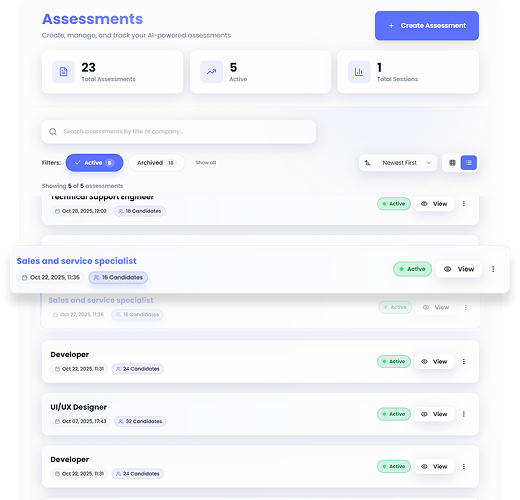
Send Assessments to One or Multiple Candidates
Hirebee makes distribution simple and scalable:
- One-time, unique test links for single applicants
- Reusable assessment invites for sending the same test to multiple candidates at once
- Bulk send options for high-volume hiring
This ensures companies can use the same structured assessment across their entire shortlist or personalize tests for individual roles when needed.
AI-Powered Scoring for Objective, Fair Results
Once candidates complete the test, Hirebee’s AI analyzes responses to provide:
- Objective scoring based on job-relevant criteria
- Easy comparison across all candidates
- Instant results and insights
- Percentile-based performance indicators
AI helps eliminate subjective bias and ensures every candidate is evaluated under the same standards.
Advanced Fraud Detection and Real-Time Penalties
Hirebee includes built-in anti-cheating tools to maintain fairness and accuracy. Any suspicious activity automatically triggers penalties, such as:
- Score reduction for rule violations
- Flagging the candidate for further review
- Disqualification in severe cases
Detection includes behaviors like switching tabs, copy/paste attempts, or unusual test activity. This creates a secure assessment environment without requiring manual monitoring.
Seamless ATS Integration
Because Hirebee Assessments is part of the Hirebee ATS, teams get a unified workflow:
- Assessment results appear directly on the candidate profile
- Recruiters can filter and sort based on scores
- Evaluations sync with hiring pipelines and feedback forms
- Managers can review results collaboratively
No external tools, no spreadsheets, no syncing errors, everything happens inside one platform.
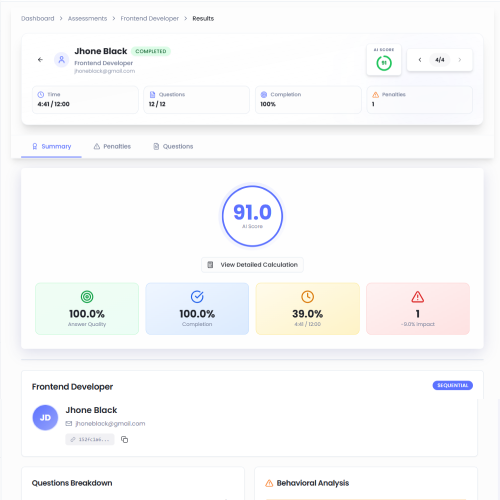
Clear Analytics and Reporting
To support data-driven hiring, Hirebee provides:
- Visual score breakdowns
- Time-to-complete and performance patterns
- Insights into which skills are strongest or weakest
- Benchmarks based on your own hiring data
This helps teams make faster, more confident decisions based on transparent evaluation data.
Smooth Candidate Experience Across All Touchpoints
Candidate experience is a key advantage of Hirebee:
- Assessments are mobile-friendly
- No account creation required
- Simple, clean test interface
- Easy instructions and guidance
- Consistent experience whether candidates apply through job boards, referrals, or your website
This reduces drop-off and ensures candidates feel the process is fair, professional, and clear.
Ethical Considerations and Best Practices
Using ethical AI hiring practices is essential to ensure fairness and transparency in recruitment. Organizations should:
- Keep assessments relevant to job requirements.
- Maintain human oversight to verify decisions.
- Be transparent with candidates about the process.
- Use diverse datasets to avoid unintentional bias.
- Review scoring models periodically to ensure consistency.
Following these principles ensures AI assessments enhance, not replace, sound hiring judgment.
The Future of Hiring With AI Assessments
As AI continues to evolve, assessments will become even more personalized, adaptive, and predictive. Organizations will rely more heavily on real-time insights, behavioral analytics, and job simulations that mirror actual work environments. The next generation of tools will combine AI accuracy with human-centered design, making hiring more efficient and equitable.
AI-powered assessments offer a transformative advantage for companies aiming to improve hiring accuracy. By combining objective scoring, speed, and predictive insights, they help teams select candidates with the right blend of skills, potential, and cultural fit. Modern platforms like Hirebee Assessments make it easier for businesses to adopt structured, fair, and data-backed evaluation practices.
If you’re ready to streamline your screening process and hire with confidence, you can explore Hirebee Assessments and sign up to try it for free.