Build Integrations Faster
Developer Tools & SDK: SDKs, Sandbox, Documentation & Integration Testing
Official SDKs for major programming languages, an isolated API sandbox with synthetic data, comprehensive documentation, and integration testing tools. Everything developers need to build and maintain Hirebee integrations.
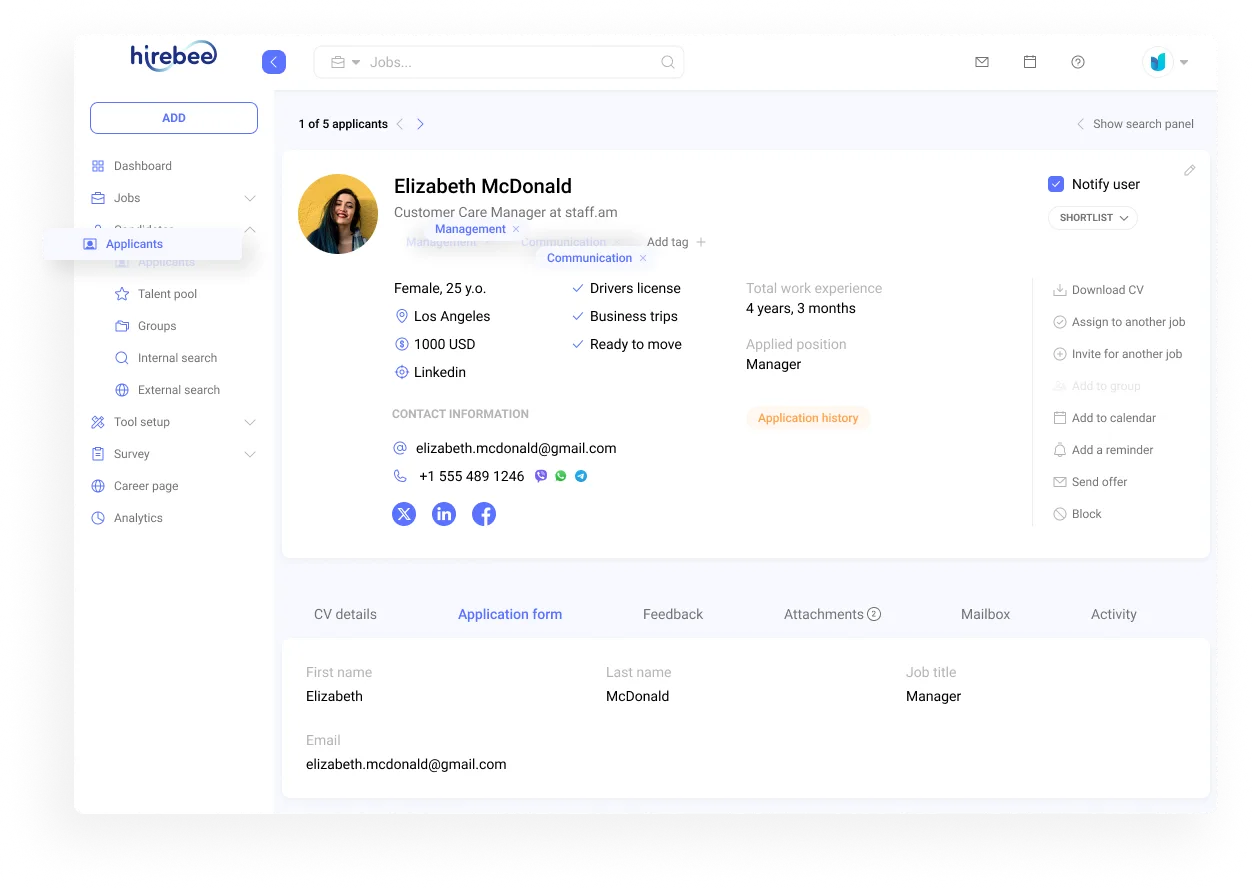
Hirebee is a highly recommended global hiring solution
Developer Tools & SDK
Official SDKs for Major Programming Languages
Raw REST APIs require developers to write boilerplate code for authentication, request construction, response parsing, error handling, and retry logic before they can write a single line of business logic. SDKs eliminate this overhead by providing idiomatic, language-native clients that handle the infrastructure concerns and let developers focus on what they're building. Hirebee provides officially maintained SDKs for the languages most commonly used in enterprise integration projects: JavaScript/TypeScript (with full type definitions for every API resource), Python (with both sync and async client options), Java, Ruby, and Go. SDK releases are versioned and published to the standard package repositories for each language — npm, PyPI, Maven Central, RubyGems, Go modules — so installation is a single package manager command. Type definitions in the JavaScript SDK and Python SDK mean that IDEs provide autocomplete and type checking for Hirebee API objects, catching errors at development time rather than at runtime in production. SDK changelogs are comprehensive: every release documents what changed, what was added, what was deprecated, and what migration steps are needed when breaking changes are introduced in major versions.
Interactive API Sandbox and Development Environment
Developing integrations against a production HR system creates unacceptable risk: test data contaminates real employee records, accidental bulk operations affect live payroll, and debugging requires working with real personal data that should be protected. Hirebee's API sandbox provides a complete, isolated copy of the API environment pre-populated with realistic synthetic data — a full set of employee records, organizational structures, performance data, and HR events that mirror a real organization without containing any actual personal information. The sandbox responds to all the same endpoints as the production API, including webhooks, authentication flows, and pagination, making it a faithful development target. Each sandbox instance is isolated per developer or development team, with the ability to reset to a clean state at any time — useful for testing workflows that require a specific starting state. Sandbox API keys are clearly distinguished from production keys in the developer console, preventing accidental production calls from development code. The interactive API explorer built into the developer portal lets developers construct API calls, see the full request and response, and copy the generated code in their language of choice — reducing the time from "I want to build this integration" to "I have working code" from hours to minutes.
Comprehensive API Documentation and Integration Guides
API documentation quality determines how fast developers can build correct integrations. Documentation that is incomplete, outdated, or written for a different version of the API creates integration bugs that take days to diagnose. Hirebee's API documentation is generated directly from the API's OpenAPI specification, ensuring it is always current with the live API. Every endpoint is documented with its full request schema, all query parameters, every possible response code and response schema, and concrete request and response examples in multiple languages. Authentication flows are documented with step-by-step walkthroughs for both OAuth 2.0 and API key authentication, with example code that developers can copy and adapt. Integration guides go beyond endpoint documentation to explain common integration patterns: how to build a new hire notification integration with webhooks, how to synchronize HR data to a data warehouse, how to build a custom approval workflow using the API, how to implement a leave balance widget in an internal employee portal. These scenario-based guides help developers understand not just what the API can do but how to use it to accomplish specific business outcomes, significantly reducing the integration development time for common use cases.
Integration Testing, Monitoring, and Support
Building an integration is the first challenge; keeping it working in production as both systems evolve is the ongoing challenge. Hirebee provides tooling that supports the full integration lifecycle from development through production monitoring. The integration testing suite lets developers write automated tests against the sandbox API that verify their integration behaves correctly across a range of scenarios — normal operation, edge cases, error conditions, and rate limit behavior. These tests can be run in CI/CD pipelines to catch integration regressions before they reach production. Production integration monitoring gives developers and administrators real-time visibility into integration health: request volume, error rates, response time percentiles, and webhook delivery success rates — all broken down by integration and API key. Alert configurations notify developers when error rates spike or webhook delivery failures exceed a threshold. API status updates communicate planned maintenance, incidents, and service degradations in real time through a status page and optional notification subscriptions. Developer support is available through a community forum for common questions, a ticketing system for integration-specific issues, and dedicated technical support for enterprise customers building complex integration architectures.

Ready to see it in action?
Join 1,000+ companies using Hirebee. Start your free trial — no credit card required.