Every HR Event, Available Instantly
REST API & Webhooks: Full HR Data Access and Real-Time Event Integration
Full REST API access to all HR data with real-time webhooks for event-driven integrations. OAuth 2.0 and API key authentication, comprehensive documentation, and production-grade reliability.
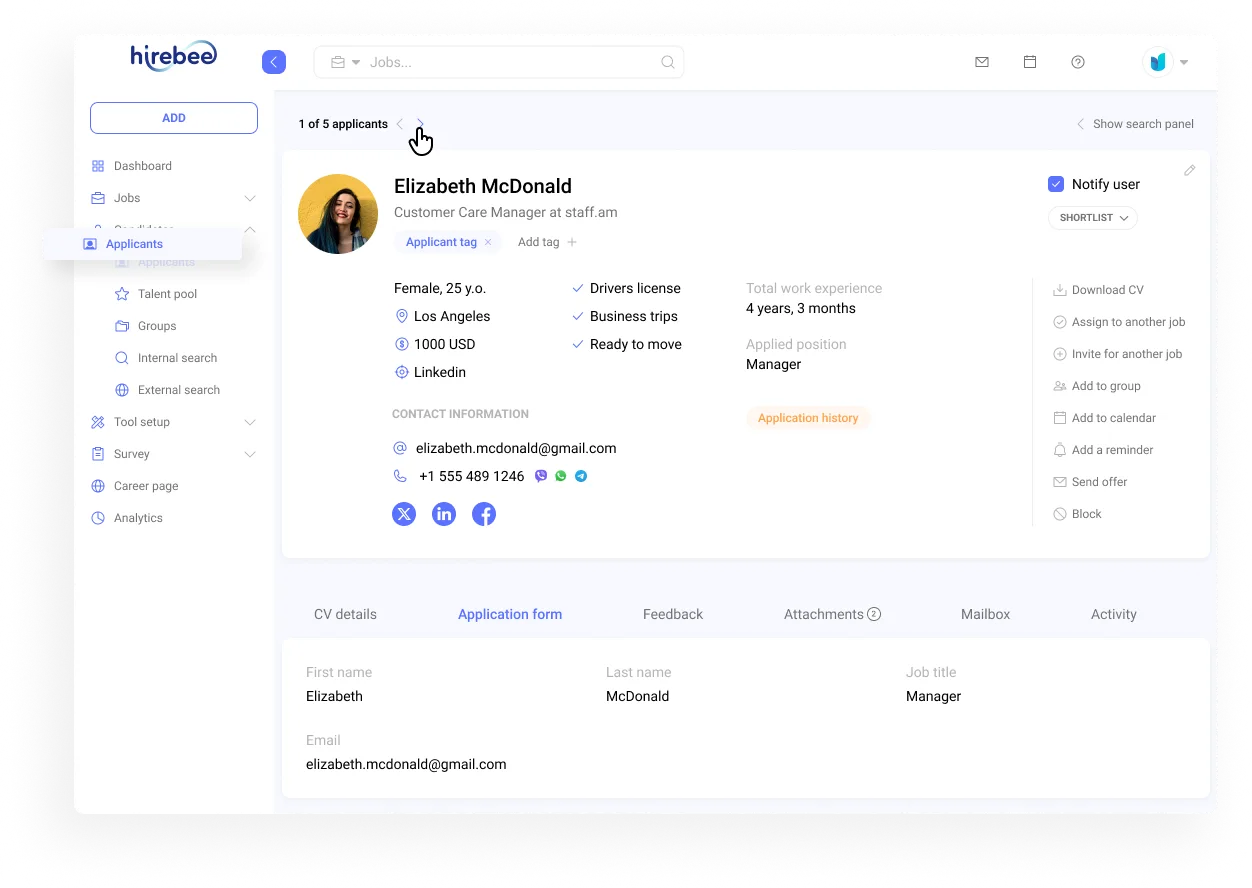
Hirebee is a highly recommended global hiring solution
REST API & Webhooks
Comprehensive REST API Covering the Full HR Data Model
Every piece of data in Hirebee is accessible through a consistent, well-designed REST API. Employees, positions, departments, performance reviews, leave requests, payroll data, recruitment pipelines, onboarding tasks, compliance records — every resource is represented as an API endpoint with standard HTTP methods (GET, POST, PUT, PATCH, DELETE) and predictable response structures. The API follows OpenAPI 3.0 specifications, meaning any tool that consumes OpenAPI specs — Postman, Insomnia, code generation tools — can immediately start working with Hirebee data without custom setup. Pagination, filtering, and field selection are standardized across all endpoints: request only the fields you need, filter by any attribute, and page through large datasets efficiently. Versioned API paths (`/v1/`, `/v2/`) ensure that integrations built today continue to work as the API evolves, with deprecation notices and migration guides provided well in advance of any breaking changes. API access is scoped at the token level — each API key carries exactly the permissions needed for its purpose, preventing over-privileged integrations from creating security exposure.
Real-Time Webhooks for Event-Driven Integrations
Polling the API to detect changes is inefficient and creates latency between when an event occurs and when downstream systems know about it. Webhooks eliminate this latency by pushing event notifications to your endpoint the moment something happens in Hirebee. Subscribe to any combination of events across the HR data model: employee hired, employee offboarded, leave request approved, performance review submitted, job offer accepted, payroll processed, policy acknowledged, asset assigned. Each webhook payload delivers the full event context — the event type, the affected resource with its complete data at the time of the event, the actor who triggered it, and a timestamp — giving receiving systems everything they need to process the event without a follow-up API call. Webhook delivery is reliable: failed deliveries are retried with exponential backoff, a delivery log shows the status of every webhook attempt, and a test delivery tool lets developers verify their endpoint is receiving payloads correctly before going live. Webhook signatures using HMAC-SHA256 allow receiving systems to verify that payloads are genuinely from Hirebee and haven't been tampered with in transit.
OAuth 2.0 Authentication and API Key Management
Hirebee supports two authentication models to suit different integration architectures. OAuth 2.0 with authorization code flow is designed for integrations that act on behalf of specific users: a third-party app requests permission to access Hirebee data for a specific user, the user authorizes the request, and the app receives an access token scoped to that user's permissions. This model is appropriate for user-facing applications, employee self-service integrations, and any scenario where actions should be attributed to the individual user rather than a system. API key authentication is designed for server-to-server integrations that operate independently of any specific user: a payroll system synchronizing compensation data, a reporting tool pulling HR metrics, or a custom internal application automating HR workflows. API keys are created with explicit permission scopes, named for easy identification, and can be rotated without disrupting the integration. A usage dashboard shows each key's request volume, error rates, and last-used timestamp, making it easy to identify stale keys that should be revoked and active integrations that are approaching rate limits.
Rate Limiting, Error Handling, and API Analytics
Production-quality integrations require predictable rate limits, clear error responses, and visibility into API performance. Hirebee's rate limiting applies per API key with configurable limits based on subscription tier, and rate limit headers in every response tell calling systems exactly how many requests remain in the current window and when it resets — enabling integrations to implement intelligent throttling rather than failing unexpectedly when the limit is reached. Error responses follow a consistent structure: an HTTP status code, a machine-readable error code, a human-readable message, and where relevant a list of validation errors with field-level detail. This consistency means error handling code written once for one endpoint works for all endpoints without special-casing. API analytics give administrators a real-time and historical view of API usage: total request volume, error rate by endpoint, latency percentiles, most active API keys, and top calling IP addresses. This visibility makes it straightforward to monitor integration health, diagnose issues when they arise, and plan capacity for high-volume integration scenarios.

Ready to see it in action?
Join 1,000+ companies using Hirebee. Start your free trial — no credit card required.